Made-to-measure shallow-depth wardrobes in Valencia
Made-to-measure shallow-depth wardrobes in Valencia are made for spaces where a standard wardrobe sticks out too far: hallways, entrance halls, narrow bedrooms or walls with a pipe running through the middle. You can store a surprising amount in very little depth if the interior is planned from the first centimetre. Here we explain how to hang clothes in less depth, which doors work best and what to measure before you start.
Shape your next wardrobe.
Try out the measurements, plan the interior layout and choose your finishes. See your idea take shape and share it with us so we can prepare your quote.
Send us your configuration with your measurements and we'll give you a guide price within 24 hours, free of charge. The measuring visit at your home comes afterwards.
How much depth do your clothes really need?
A standard wardrobe is around sixty centimetres deep, the measurement designed for hanging clothes on a hanger at right angles to the front. When the space can't take that much, you need to decide what you're storing and how. With thirty-five or forty centimetres you can already fit folded clothes, boxes, shoes and plenty of underwear and lingerie.
For hanging clothes, the trick is to turn the rail: instead of fitting it front-on, it is mounted sideways and the hangers pull out like a fan. This needs around forty-five centimetres of usable depth. Before we draw anything up, we ask you to measure the length of your favourite coats and shirts, because that figure decides the layout.
The difference between overall depth and usable depth
The depth you see on the plan is not the depth you'll actually get to use. From the outer depth you have to subtract the thickness of the sides, the back panel, the clearance for the doors and, if there are any, the tracks of a sliding door. A wardrobe that is forty centimetres deep on the outside can end up with thirty-two centimetres of usable depth.
That's why usable depth is the figure we design around. We calculate it for each unit and check it against the items you plan to store: shoe boxes, an iron, small suitcases, folded blankets. In a shallow wardrobe it's easier to get things right by measuring what you need to store than by copying dimensions from a catalogue.
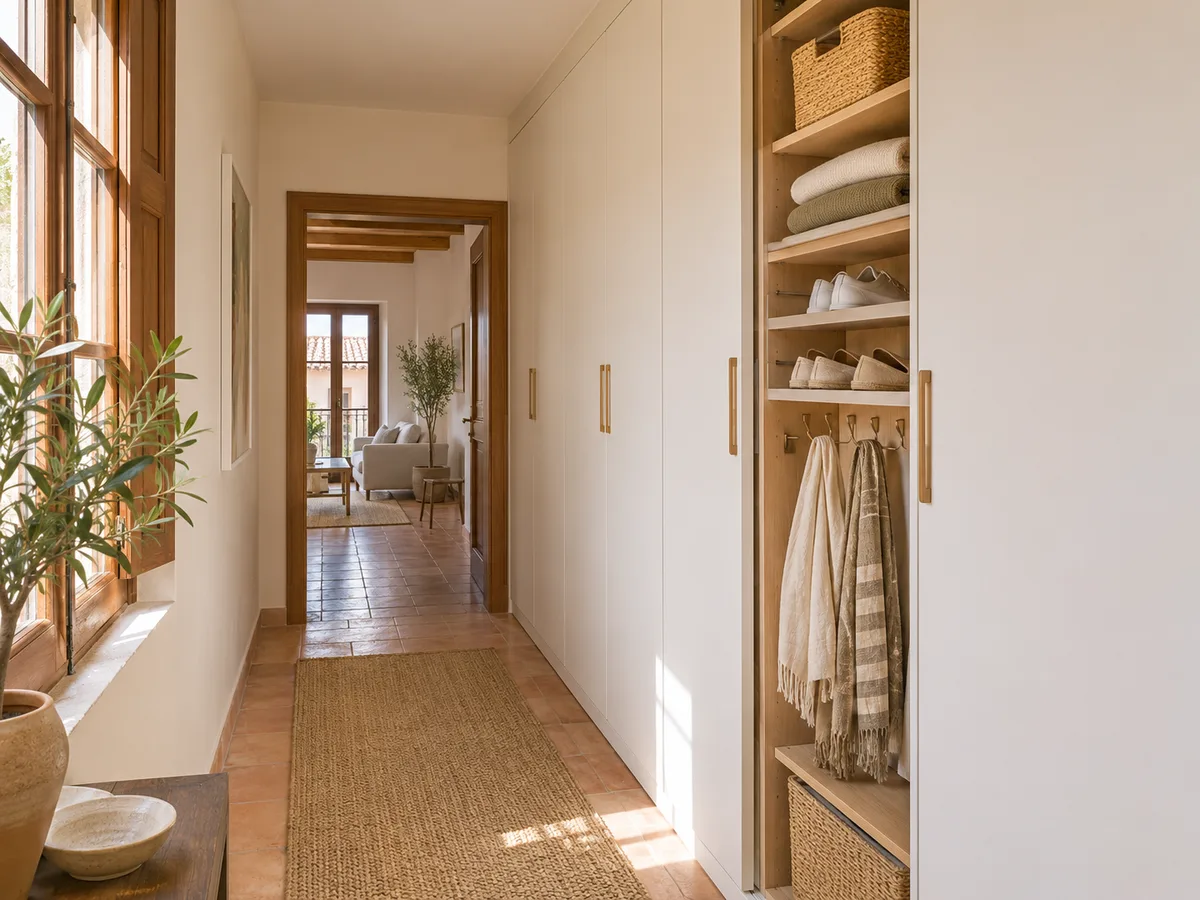
Doors that don't take up depth
In a shallow space every door counts. A sliding door takes up two tracks and some of the interior depth, so the usable depth drops by around four or five centimetres. A hinged door doesn't reduce the interior depth, but it needs space in front to swing open, which a narrow hallway sometimes doesn't have.
Bifold doors or narrow hinged doors are usually the sensible middle ground in hallways. In entrance halls and passageways, slim doors that open wide let a person get past without getting in the way. We look at this with you using the plan of the space rather than following a fixed rule.
Have you already measured the space?
Send us a photo and the approximate measurements on WhatsApp and we'll give you some initial guidance.
How to make the most of a shallow wardrobe
- 01
The key is to organise vertically and by how often you use things. The narrowest shelves, thirty to thirty-five centimetres deep, are ideal for folded clothes and baskets. Shallow drawers hold socks, belts and accessories that would get lost at the back of a normal wardrobe.
- 02
Angled shoe racks are particularly useful in shallow wardrobes, because they store shoes toe-down and take up less than twenty centimetres. A single narrow unit with this system can replace a bulkier conventional shoe rack. We decide based on the shoes you actually have at home. Height-adjustable shelves also let you rearrange the interior when what you store changes, without touching the structure of the wardrobe.
Where a shallow wardrobe fits in a home in Valencia
Shallow-depth wardrobes are common in entrance halls, in the stretch of hallway leading to the bedrooms, in the recess beside a door and on the wall of a utility room. They also work in bedrooms where the bed leaves little room to pass and you can't spare an inch of floor space.
In each of these spots the plan is different. In the entrance hall you want coats and shoes close at hand; in the hallway, bedding and towels; in the bedroom, seasonal clothing. With the measurements of the space and a photo, we'll propose a specific layout rather than a generic one.
Common obstacles on shallow walls
A shallow depth often comes with an obstacle: a column, a pipe, a tall skirting board, a radiator or a door frame. The usual solution is to work around it with a shorter unit, a recess or a front that hides it behind a removable panel.
We note everything that protrudes from the wall, with its width, height and distance from the floor. A twelve-centimetre skirting board, for example, means raising the wardrobe or cutting back the rear panel. Accurate measuring saves corrections during installation and avoids uneven gaps between the wardrobe and the wall. In a shallow wardrobe, a ten-centimetre obstacle takes up a quarter of the available space, so nothing is left to guesswork.
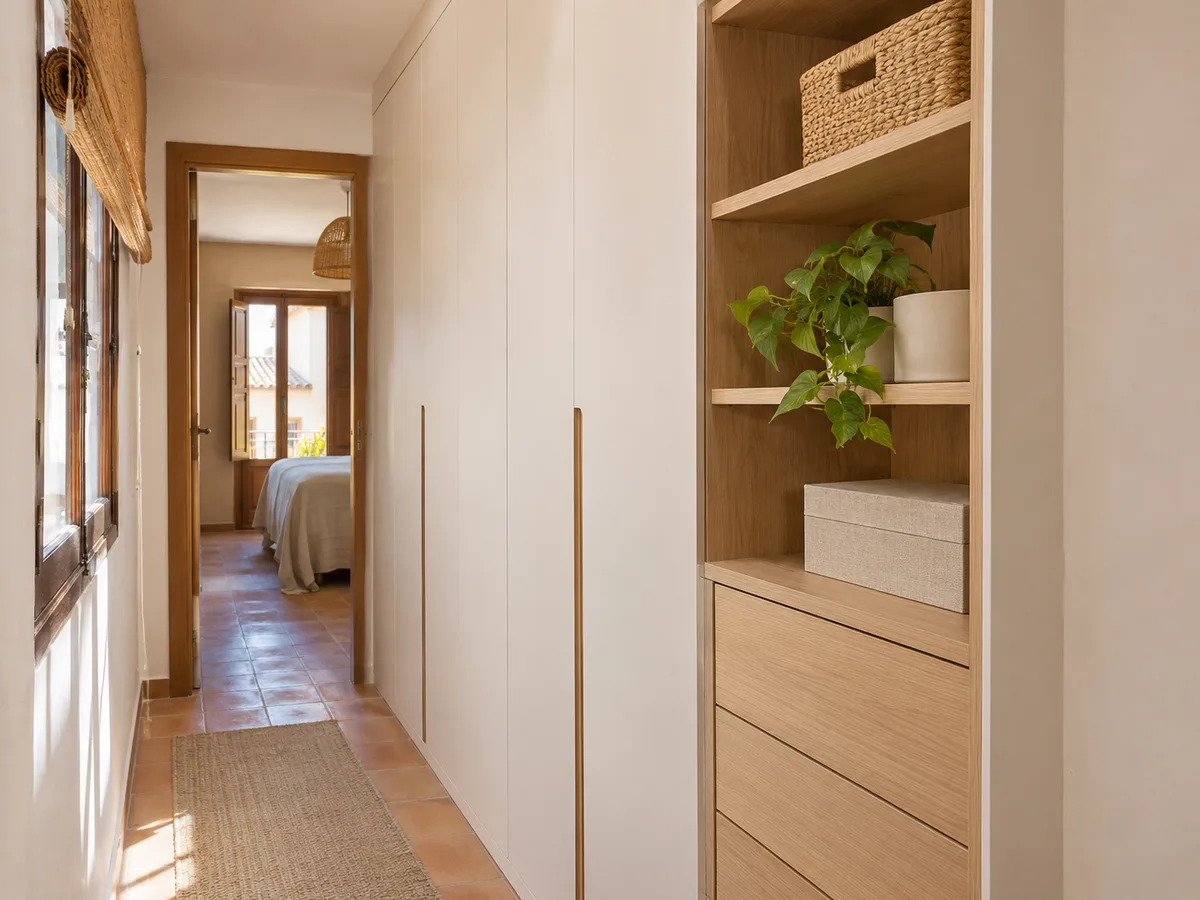
Request a measuring visit in Valencia
- 01You leave us your name and your area.
- 02We message you on WhatsApp to agree a day.
- 03The measuring visit costs €50 and is free if you place an order.
Materials and finishes for a slim front
With less volume, a shallow wardrobe looks more like a line on the wall than a piece of furniture. Light tones, matt white or finishes that match the hallway wall reduce the sense of bulk.
In a hallway, plain handleless doors that open with a push avoid snagging on clothes or bags. In an entrance hall, a mirrored door on one panel helps you see the full picture before heading out. These are decisions made once the edging and hardware have been settled. If the hallway is dark, a discreet strip of light on the side brightens the whole unit and helps you find things without opening every door.
When shallow depth isn't enough
- 01
There are spaces where it's worth considering another option. If you need to hang a lot of long clothes and the depth is no more than thirty centimetres, it may be better to split the storage between two areas of the home, or to use the shallow unit for folded items and move the hangers to another wardrobe.
- 02
Combining the two can also be a good idea: a shallow section in the hallway for bedding and shoes, and a deeper one in the bedroom for hanging clothes. We look at these combinations with you, using the measurements of each room, so the solution is genuinely useful and not a wardrobe that looks good but is awkward to use.
How to order your shallow-depth wardrobe
Measure the depth at three points: top, middle and bottom, because walls are rarely parallel. Add the width, the height and the position of sockets, switches and radiators. A photo from the front and another from the side complete the picture.
If you're torn between two interior layouts, make a list of what you want to store and its approximate size; it makes it easy to see which option leaves the most usable depth. With that information you can prepare the design in the configurator and send it in for a quote. We work in Valencia and the surrounding province; the measuring visit costs €50 if the order isn't confirmed and is free if you go ahead, and manufacturing usually takes two to three weeks from the deposit.
Enquiry
Tell us about your project in Valencia
- 1We read your message and look at your photos.
- 2We reply on WhatsApp with a first figure.
- 3We measure up and prepare the final quote. The measuring visit costs €50 if you don't go ahead with the order and is free if you do.
We don't cut a single board until you've approved the design and the price.
Questions
Frequently asked questions about wardrobes in Valencia
After installation: warranty and care for your wardrobe.
What is the minimum depth for a wardrobe?
For clothes hung sideways, around forty-five centimetres of usable depth is enough. If you only store folded clothes, boxes and shoes, you can work with thirty-five centimetres or even less.
Which doors suit a shallow wardrobe?
It depends on the space in front. If there is room to swing, a hinged door doesn't reduce the interior depth; if there isn't, a sliding or bifold door avoids the swing, although a sliding door does reduce the usable depth slightly.
Can you hang clothes in a shallow-depth wardrobe?
Yes, with pull-out rails or rails fitted sideways. Long, bulky garments are the main constraint, which is why we measure them before designing.
Can a shallow wardrobe go all the way up to the ceiling?
Yes. In fact it's the best way to gain capacity when there's no depth to spare: more height, a top cupboard for things you rarely use and well-spaced shelves.
How much does a shallow-depth wardrobe cost?
The quote is drawn up after measuring and depends on the dimensions, the interior and the finishes. You can prepare the design in the configurator and receive the proposal based on the real figures.
Shall we talk about your project?
Send us a photo of the space and some approximate measurements on WhatsApp: we'll give you some initial guidance and arrange the measuring visit.